
mRNA CDMO Market Size, Share, Trends, Report 2026 To 2035
mRNA CDMO Market (By Service Type: mRNA Drug Substance Manufacturing, Plasmid DNA Template Manufacturing, LNP Formulation & Encapsulation, Fill-Finish, Process & Analytical Development, Testing, Release & Regulatory Support; By RNA Modality: Conventional (Non-Replicating) mRNA, Self-Amplifying mRNA (saRNA), Circular RNA & Other RNA Formats; By Application: Infectious Disease Vaccines, Oncology, Protein Replacement & Rare Diseases, Gene Editing & Cell Therapy, Others; By Delivery Platform: Lipid Nanoparticles (LNP), Polymer-Based & Other Non-Viral Delivery; By Scale of Operation: Preclinical, Clinical, Commercial; By End User: Biotechnology Companies, Pharmaceutical Companies, Academic & Government Research Institutes) - Global Industry Analysis, Size, Share, Regional Analysis, Trends and Forecast 2026 - 2035
- Last Updated: 20 Nov 2026
- Report Code: ARC4014
- Category: Healthcare and Pharmaceuticals
mRNA CDMO Market Size and Forecast Report 2026 To 2035
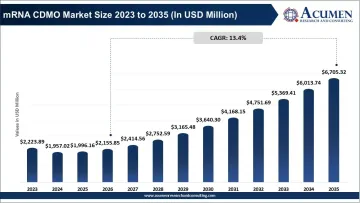
The global mRNA CDMO market size was valued at USD 1,996.16 million in 2025 and is expected to reach around USD 6,705.32 million by 2035; expanding at a CAGR of 13.4% during the forecast period of 2026-2035. The mRNA CDMO market is expanding due to increasing outsourcing of RNA manufacturing, growing vaccine and therapeutic pipelines, rising investments in GMP facilities, advancements in lipid nanoparticle delivery, and increasing demand for scalable production, analytical testing, and specialized contract manufacturing services.
mRNA CDMO Market Value & Projections
- Base Year Market Size (2025): $1,996.16 million
- Current Year Market Size (2026): $2,155.85 million
- Estimated Year Market Size (2035): $6,705.32 million
- Forecast Period CAGR (2026-2035): 13.4%
Key Takeaways
- By Region: North America dominated the regional segment with a 42.0% share in 2025. Its leadership is supported by an established biotechnology ecosystem, advanced pharmaceutical manufacturing infrastructure, substantial mRNA research investments, and strong demand for specialized contract manufacturing services.
- By Service Type: mRNA drug substance manufacturing dominated the service type segment with a 34% share in 2025. Its leading position is supported by the essential role of in vitro transcription, capping, and purification in producing high-quality mRNA products.
- By RNA Modality: Conventional non-replicating mRNA dominated the RNA modality segment with an 86.0% share in 2025. Its established manufacturing ecosystem, extensive development experience, and broad application in vaccine and therapeutic development support its leading position.
- By Application: Infectious disease vaccines dominated the application segment with a 58% share in 2025. Established mRNA vaccine manufacturing capabilities and continued research into infectious diseases support the segment's substantial contribution to CDMO demand.
- By Delivery Platform: Lipid nanoparticles (LNP) dominated the delivery platform segment with a 90% share in 2025. Their established role in protecting mRNA molecules and facilitating intracellular delivery supports widespread adoption across vaccine and therapeutic manufacturing.
- By Scale of Operation: Clinical manufacturing dominated the scale of operation segment with a 46.0% share in 2025. Demand is supported by the growing pipeline of mRNA candidates requiring GMP-compliant production, clinical batch manufacturing, and specialized analytical services.
- By End User: Biotechnology companies dominated the end-user segment with a 60.0% share in 2025. Their reliance on outsourced manufacturing, specialized technical expertise, and GMP infrastructure supports demand for external mRNA CDMO partnerships.
mRNA CDMO Market Overview & Scope
The global mRNA Contract Development and Manufacturing Organization (CDMO) market encompasses specialized services supporting the development, production, formulation, testing, and commercial manufacturing of messenger RNA-based products for pharmaceutical and biotechnology companies. The market includes mRNA drug substance manufacturing, plasmid DNA template production, in vitro transcription (IVT), capping, purification, lipid nanoparticle (LNP) formulation, encapsulation, fill-finish, process development, analytical testing, and regulatory support.
Demand is also increasing across infectious disease vaccines, oncology, protein replacement, rare diseases, and gene-editing applications. The market is evolving toward integrated manufacturing partnerships offering end-to-end development and production capabilities, with particular emphasis on GMP compliance, batch consistency, process scalability, product stability, and manufacturing efficiency. Regional investments in biotechnology infrastructure and the expansion of clinical and commercial production capacity are further shaping the competitive landscape of the global mRNA CDMO industry.
mRNA CDMO Market Investment Outlook
- Moderna announced an investment exceeding USD 140 million in November 2025 to expand its Moderna Technology Center in Norwood, Massachusetts. The project includes bringing drug product manufacturing and fill-finish capabilities in-house, with completion targeted for the first half of 2027. This expansion is intended to support end-to-end domestic mRNA manufacturing for clinical and commercial supply.
- AGC Biologics announced a USD 350 million investment in a new Yokohama manufacturing facility in April 2026. The facility is designed to support mRNA, cell therapy, and mammalian biologics manufacturing. Its planned mRNA infrastructure includes two IVT lines, purification lines, and LNP formulation lines, with production capacity of up to 50 grams of mRNA using single-use technology. GMP manufacturing is targeted to begin in 2027.
- Evonik announced a new GMP manufacturing facility in Vancouver, Canada, in August 2026, to expand its lipid-based drug delivery capabilities. The facility is designed to manufacture specialized lipid components for mRNA therapeutics, gene therapies, and biologics, with operations expected to begin in 2027. The expansion strengthens North American LNP supply capabilities and supports customer requirements for clinical-to-commercial scale-up.
- Kaneka Eurogentec completed the accreditation of an additional commercial mRNA GMP manufacturing facility in Belgium in June 2025. The expansion increases its capacity to manufacture mRNA for vaccines, protein replacement, and gene-editing applications. The facility is designed to support late-stage clinical and commercial production, strengthening the company's position in specialized RNA manufacturing services.
- Lonza expanded its mRNA manufacturing capabilities through an integrated mRNA and LNP manufacturing complex at its Geleen facility in the Netherlands. The infrastructure combines process and analytical development, cGMP manufacturing, and quality control capabilities. Its service offering covers early development, IND-enabling activities, clinical manufacturing, and small-scale commercial production, supporting demand for integrated outsourced RNA manufacturing.
- Canada's biomanufacturing expansion includes a 36,000-square-foot cGMP manufacturing centre in Prince Edward Island, supporting mRNA, plasmid DNA, and LNP formulation. The planned capacity includes production of up to 160 million vaccine and therapeutic doses annually and fill-finish capacity of up to 70 million doses annually. This infrastructure represents an important development in regional manufacturing resilience and domestic RNA production capabilities.
mRNA CDMO Market Dynamics
Growth Drivers
- Increasing Outsourcing of mRNA Manufacturing: Biotechnology and pharmaceutical companies are increasingly outsourcing mRNA production to specialized CDMOs to reduce capital expenditure and access established GMP infrastructure. The expansion of clinical-stage RNA pipelines and growing demand for specialized IVT, purification, LNP formulation, and fill-finish capabilities are supporting long-term outsourcing opportunities across development and commercial manufacturing.
- Expansion of mRNA Therapeutic Pipelines: Increasing research into mRNA applications across infectious diseases, oncology, rare genetic disorders, and protein replacement is expanding the addressable market for contract manufacturing services. The growing diversity of RNA-based candidates is creating demand for flexible production platforms, specialized analytical testing, and scalable manufacturing processes that support different therapeutic applications.
Restraints
- High Manufacturing Infrastructure and Capital Costs: Establishing an mRNA manufacturing facility requires substantial investment in GMP cleanrooms, specialized production equipment, analytical laboratories, quality management systems, and controlled storage infrastructure. Smaller CDMOs face financial barriers to developing integrated manufacturing capabilities, while maintaining operational efficiency becomes challenging when production demand and facility utilization fluctuate.
- Complex Manufacturing and Product Quality Requirements: mRNA manufacturing involves multiple sensitive processes, including plasmid DNA preparation, in vitro transcription, capping, purification, and formulation. Variability in raw materials, process conditions, and product characteristics can affect manufacturing consistency. Maintaining reproducible quality across different production batches increases analytical requirements, validation costs, and operational complexity.
Key Opportunities
- Development of Next-Generation RNA Manufacturing: Growing research into self-amplifying mRNA, circular RNA, and other emerging RNA formats is creating opportunities for specialized CDMOs. These modalities require differentiated process development, purification, formulation, and analytical capabilities. Manufacturers investing in adaptable platforms can expand their service portfolios and support biotechnology companies developing next-generation RNA therapeutics.
- Expansion of Personalized Oncology and Gene-Editing Applications: Increasing development of individualized cancer vaccines, editor mRNA, and RNA-enabled gene-editing therapies is creating demand for flexible and smaller-batch manufacturing models. CDMOs capable of supporting rapid production cycles, customized formulations, and stringent analytical characterization can benefit from emerging clinical programs and specialized therapeutic manufacturing requirements.
Challenges
- Manufacturing Scalability and Batch Consistency: Scaling mRNA production from laboratory and clinical batches to commercial volumes requires consistent process performance, reliable raw material supply, and validated manufacturing parameters. Differences in mixing, reaction conditions, purification efficiency, and LNP encapsulation can affect product quality. CDMOs must maintain reproducibility while increasing output and accommodating different customer requirements.
- Regulatory Complexity and Technology Transfer: mRNA CDMOs must navigate evolving regulatory expectations, product-specific quality requirements, and differences across international markets. Technology transfer between development laboratories and commercial facilities can introduce process variability and validation challenges. Maintaining documentation, analytical comparability, GMP compliance, and consistent quality standards across manufacturing locations requires substantial technical and regulatory expertise.
Regulatory & Quality Standards Landscape
| Country / Region | Regulatory Authority | Applicable Regulations & Standards |
|---|---|---|
| United States | U.S. Food and Drug Administration (FDA) | 21 CFR Parts 210 and 211; applicable biologics regulations under 21 CFR Parts 600–680; FDA guidance for CMC information |
| Europe | European Medicines Agency (EMA); National Competent Authorities | EU GMP Guidelines, EudraLex Volume 4, Annex 1, and EMA quality guidance for mRNA vaccines |
| China | National Medical Products Administration (NMPA) | Drug Administration Law, Drug Manufacturing Quality Management Practices (GMP), and applicable biologics and clinical trial requirements |
| Japan | Pharmaceuticals and Medical Devices Agency (PMDA); Ministry of Health, Labour and Welfare (MHLW) | Japanese GMP Ministerial Ordinance, Pharmaceuticals and Medical Devices Act (PMD Act), and applicable biological product standards |
| India | Central Drugs Standard Control Organization (CDSCO); State Drug Regulatory Authorities | Drugs and Cosmetics Act, 1940; Drugs Rules, 1945; New Drugs and Clinical Trials Rules, 2019; applicable Schedule M GMP requirements |
mRNA CDMO Market Segmental Insights
Service Type Insights
mRNA Drug Substance Manufacturing (IVT, Capping, Purification): mRNA drug substance manufacturing dominated the service type segment with a 34.0% share in 2025, valued at USD 678.69 million. Its position is supported by the essential role of in vitro transcription, capping, purification, and other core manufacturing processes in producing high-quality mRNA. Increasing outsourcing of specialized production activities is supporting demand for dedicated manufacturing capacity.
mRNA CDMO Market Share, By Service Type, 2025 & 2035 (%)
| Service Type | Revenue Share, 2025 (%) | Revenue Share, 2035 (%) |
|---|---|---|
| mRNA drug substance manufacturing | 34% | 30% |
| Plasmid DNA template manufacturing | 12% | 10% |
| LNP formulation & encapsulation | 20% | 22% |
| Fill-finish | 14% | 14% |
| Process & analytical development | 14% | 16% |
| Testing, release & regulatory support | 6% | 8% |
LNP Formulation & Encapsulation: LNP formulation and encapsulation represented the second-largest service type segment with a 20.0% share in 2025, generating USD 399.23 million. The growing use of lipid nanoparticles for protecting mRNA molecules and facilitating intracellular delivery supports demand for specialized formulation capabilities. CDMOs are increasingly required to provide formulation optimization, encapsulation, and characterization services.
RNA Modality Insights
Conventional (Non-Replicating) mRNA: Conventional non-replicating mRNA dominated the RNA modality segment with an 86.0% share in 2025, valued at USD 1,716.70 million. Its established manufacturing processes, extensive clinical development experience, and broad application across infectious disease vaccines and therapeutic development support its leading position. Existing manufacturing infrastructure and familiarity with conventional mRNA production further contribute to outsourcing demand.
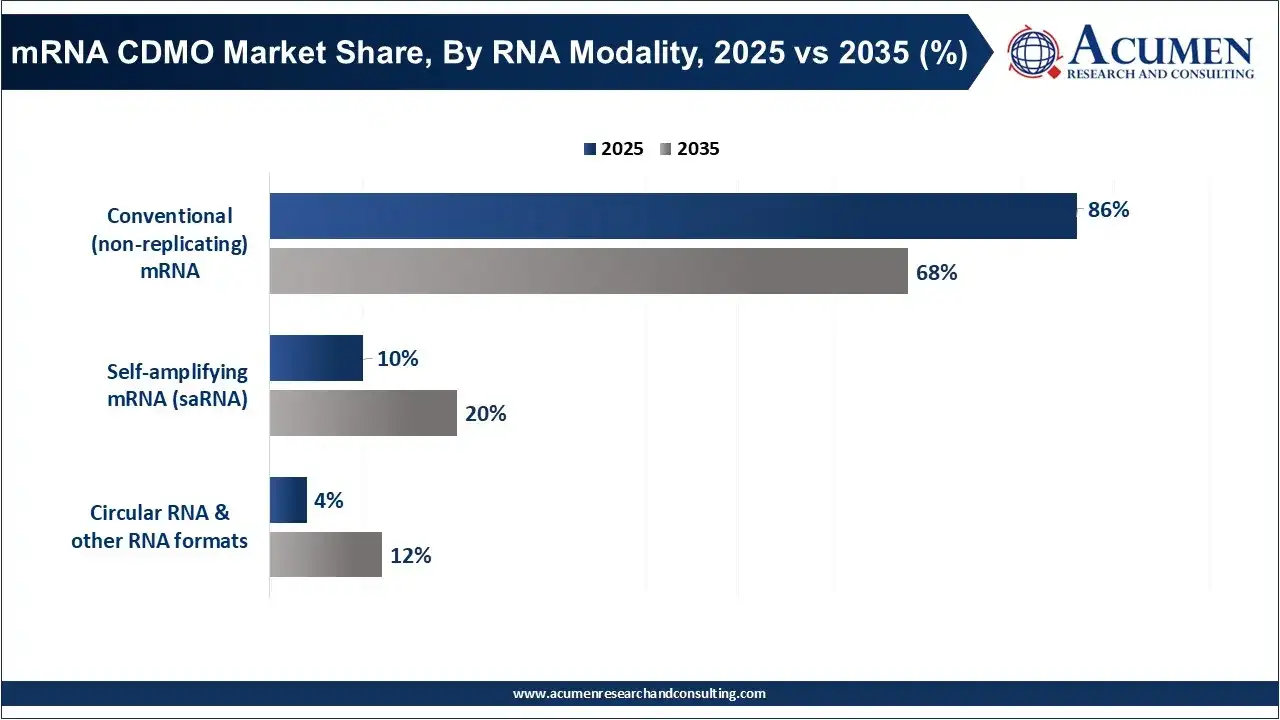
Circular RNA & Other RNA Formats: Circular RNA and other RNA formats are expected to be the fastest-growing modality category, registering a CAGR of 25.6% from 2026 to 2035. Their combined market share is projected to increase from 4.0% in 2025 to 12.0% by 2035. Growing research into RNA stability, prolonged protein expression, and alternative therapeutic delivery approaches is encouraging investment in these emerging modalities.
Application Insights
Infectious Disease Vaccines: Infectious disease vaccines dominated the application segment with a 58.0% share in 2025, valued at USD 1,157.77 million. The established use of mRNA technology in vaccine development, supported by existing manufacturing infrastructure and experience with large-scale production, contributes to its leading position. Continued research into respiratory, emerging, and re-emerging infectious diseases supports demand for outsourced mRNA production. The segment is projected to reach USD 2,413.91 million by 2035, at a CAGR of 8.0%.
mRNA CDMO Market Share, By Application, 2025 & 2035 (%)
| Application | Revenue Share, 2025 (%) | Revenue Share, 2035 (%) |
|---|---|---|
| Infectious disease vaccines | 58% | 36% |
| Oncology | 20% | 32% |
| Protein replacement & rare diseasesa | 8% | 10% |
| Gene editing & cell therapy | 6% | 13% |
| Others | 8% | 9% |
Gene Editing & Cell Therapy (Editor mRNA, In Vivo CAR-T): Gene editing and cell therapy is expected to be the fastest-growing application category, registering a CAGR of 22.1% from 2026 to 2035. Its share is projected to increase from 6.0% in 2025 to 13.0% by 2035. Growing development of editor mRNA, in vivo CAR-T approaches, and other RNA-enabled genetic modification technologies is creating demand for specialized manufacturing and formulation services.
Delivery Platform Insights
Lipid Nanoparticles (LNP): Lipid nanoparticles dominated the delivery platform segment with a 90.0% share in 2025, valued at USD 1,796.54 million. Their established role in protecting mRNA from degradation and facilitating cellular uptake supports widespread adoption across vaccine and therapeutic applications. Existing formulation expertise and established manufacturing processes further strengthen demand for LNP-related CDMO services.
Polymer-Based & Other Non-Viral Delivery: Polymer-based and other non-viral delivery platforms represented the second-largest segment with a 10.0% share in 2025, generating USD 199.62 million. Research into alternative delivery materials is creating opportunities to address limitations associated with conventional delivery systems. Growing interest in improving delivery efficiency, formulation flexibility, and tissue-specific targeting is supporting further development.
Scale of Operation Insights
Clinical: Clinical-scale manufacturing dominated the scale of operation segment with a 46.0% share in 2025, valued at USD 918.23 million. The substantial pipeline of mRNA candidates undergoing clinical development creates demand for GMP-compliant production, process optimization, analytical testing, and batch manufacturing. CDMOs play an important role in supporting clinical supply requirements across different development stages.
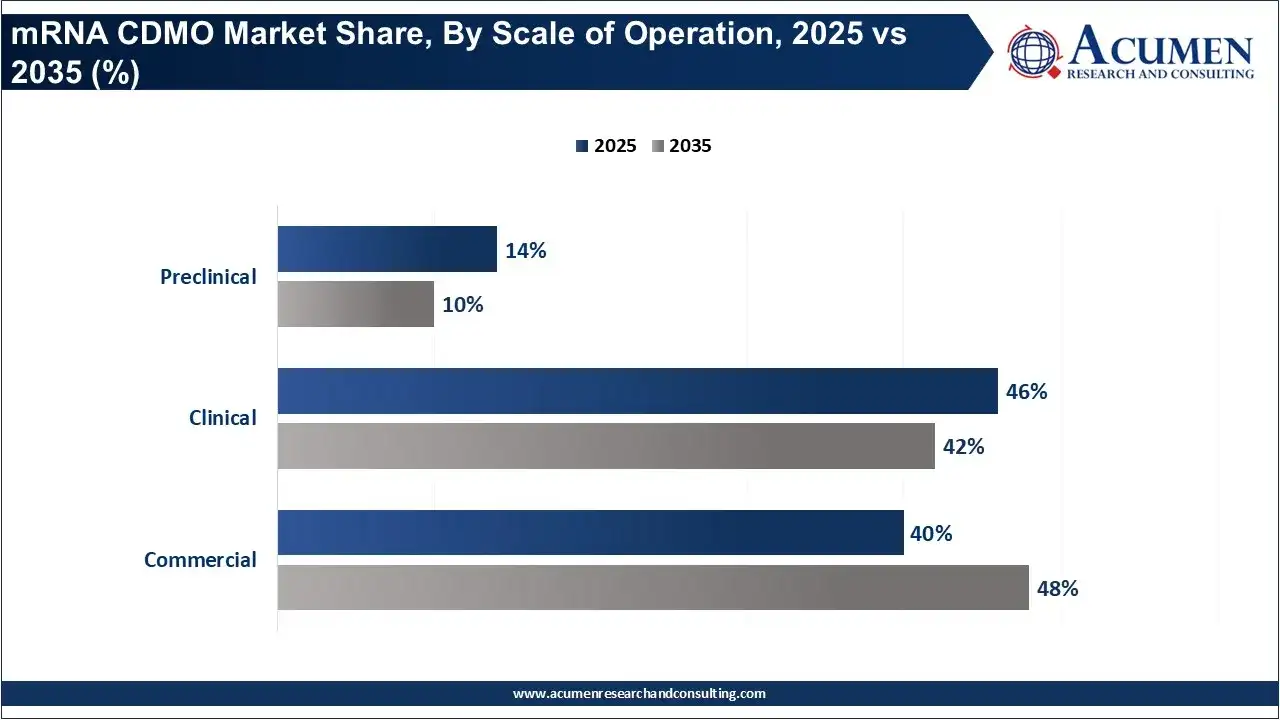
Commercial: Commercial-scale manufacturing represented the second-largest segment with a 40.0% share in 2025, generating USD 798.46 million. Increasing commercialization opportunities for mRNA-based vaccines and therapeutics are driving demand for scalable manufacturing infrastructure, reliable supply chains, and consistent product quality. Pharmaceutical and biotechnology companies are increasingly seeking partners capable of supporting technology transfer and large-volume production.
Preclinical: Preclinical manufacturing accounted for a 14.0% share in 2025, valued at USD 279.46 million. This category supports early-stage mRNA research through small-batch production, formulation screening, process development, and preliminary analytical characterization. Demand is associated with biotechnology startups, academic researchers, and pharmaceutical developers evaluating new RNA-based candidates.
End User Insights
Biotechnology Companies: Biotechnology companies dominated the end-user segment with a 60.0% share in 2025, valued at USD 1,197.70 million. Their reliance on outsourced manufacturing reflects the high capital requirements, technical complexity, and specialized infrastructure associated with mRNA production. Smaller and emerging biotechnology developers frequently depend on CDMOs for process development, GMP manufacturing, analytical testing, and clinical supply.
mRNA CDMO Market Share, By End User, 2025 & 2035 (%)
| End User | Revenue Share, 2025 (%) | Revenue Share, 2035 (%) |
|---|---|---|
| Biotechnology companies | 60% | 56% |
| Pharmaceutical companies | 28% | 32% |
| Academic & government research institutes | 12% | 12% |
Pharmaceutical Companies: Pharmaceutical companies represented the second-largest end-user segment with a 28.0% share in 2025, generating USD 558.92 million. Their growing involvement in RNA-based therapeutics, vaccine development, and strategic biotechnology partnerships is supporting demand for external manufacturing expertise. Established pharmaceutical developers also use CDMOs to expand production capacity, accelerate development timelines, and reduce manufacturing infrastructure investments.
mRNA CDMO Market Regional Insights
Why Does North America Dominate the mRNA CDMO Market?
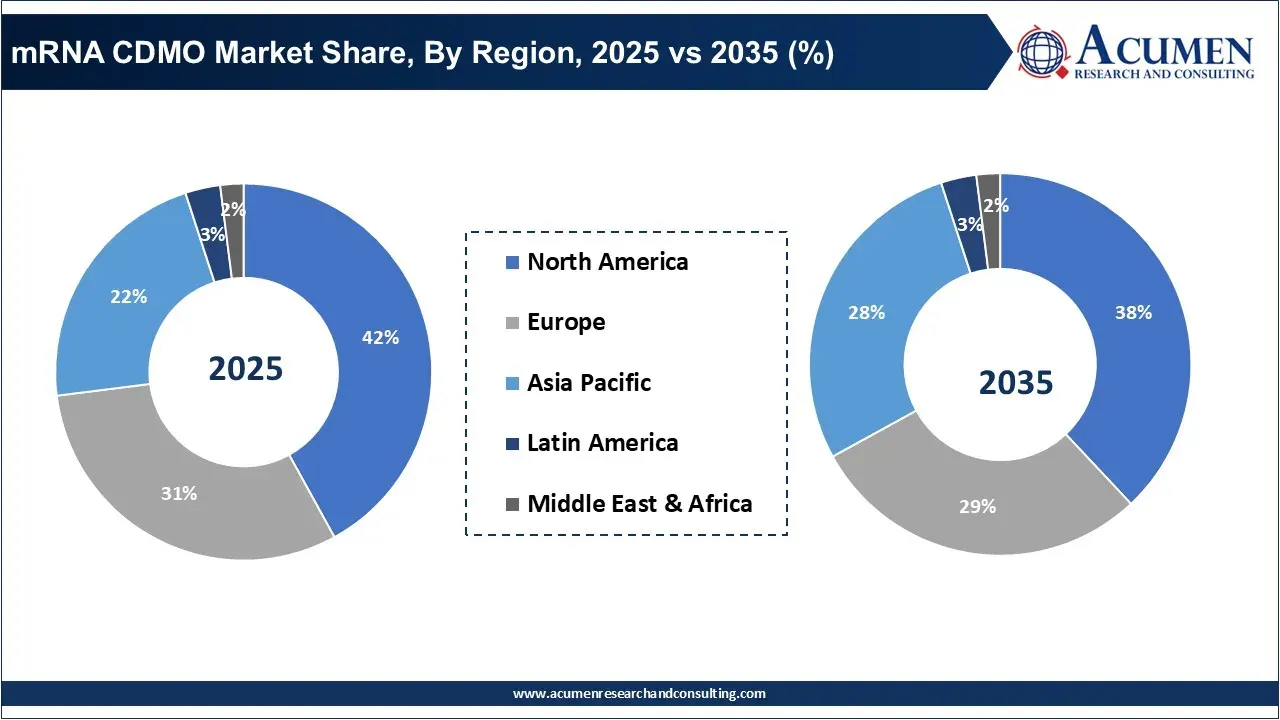
North America dominated the mRNA CDMO market with a 42.0% share in 2025, valued at USD 838.39 million. The region benefits from a well-established biotechnology ecosystem, substantial pharmaceutical research investments, and the presence of leading mRNA technology developers. The United States represents the primary contributor, supported by extensive clinical research infrastructure, established GMP manufacturing capabilities, and strong investment in vaccine and therapeutic development.
Increasing outsourcing of mRNA drug substance manufacturing, LNP formulation, analytical testing, and fill-finish activities is strengthening the role of specialized CDMOs. Furthermore, growing development of personalized cancer vaccines, gene editing applications, and RNA-based treatments is expanding the demand for flexible manufacturing platforms.
Strategic collaborations between biotechnology companies, pharmaceutical developers, and contract manufacturers are also supporting capacity expansion. North America is projected to maintain its leading position, although its market share is expected to moderate to 38.0% by 2035 as other regions expand their manufacturing capabilities.
Why Is Asia-Pacific the Fastest-Growing Region in the mRNA CDMO Market?
Asia-Pacific is expected to register the fastest regional growth, with a projected CAGR of 16.2% from 2026 to 2035. The region's market share is expected to increase from 22.0% in 2025 to 28.0% by 2035. China, Japan, South Korea, India, and Australia are contributing to the expansion of regional RNA research and biopharmaceutical manufacturing capabilities. Increasing government support for biotechnology, growing investments in domestic pharmaceutical infrastructure, and expanding clinical research activities are creating opportunities for specialized CDMOs.
The region also benefits from competitive manufacturing costs, an expanding biotechnology startup ecosystem, and increasing interest in developing locally manufactured vaccines and advanced therapeutics. Demand for mRNA drug substance production, LNP formulation, and analytical development services is expected to increase as more RNA-based candidates advance through clinical pipelines.
Additionally, growing partnerships between international pharmaceutical companies and Asian manufacturing providers are supporting technology transfer and capacity development. These factors position Asia-Pacific as an increasingly important destination for outsourced mRNA manufacturing.
How Is Europe Strengthening Its Position in the mRNA CDMO Market?
Europe represented the second-largest regional market with a 31.0% share in 2025, valued at USD 618.81 million. The region benefits from an established pharmaceutical manufacturing industry, advanced biotechnology research capabilities, and a strong academic research ecosystem. Germany, the United Kingdom, France, Switzerland, and Belgium are important contributors to regional biopharmaceutical development and manufacturing activities.
The presence of specialized biotechnology companies and established vaccine developers supports demand for outsourced mRNA production, formulation, and analytical services. European pharmaceutical companies are also investing in next-generation vaccine technologies, personalized oncology treatments, and RNA-based therapeutics.
Regulatory quality requirements and increasing emphasis on manufacturing consistency are encouraging developers to collaborate with experienced CDMOs offering GMP-compliant facilities and specialized quality control capabilities. Furthermore, cross-border research collaborations and public-private partnerships are supporting the development of advanced RNA manufacturing infrastructure.
Company Profiles
- Lonza Group AG (Switzerland): Lonza provides integrated mRNA development and manufacturing services, including drug substance production, process development, LNP formulation, analytical testing, and GMP manufacturing for clinical and commercial applications.
- Thermo Fisher Scientific (United States): Through its Patheon and specialized manufacturing capabilities, Thermo Fisher supports mRNA development, plasmid DNA production, drug substance manufacturing, formulation, and pharmaceutical manufacturing services.
- Catalent (United States): Catalent offers pharmaceutical development, biologics manufacturing, formulation, and sterile fill-finish capabilities that support the development and production requirements of advanced therapeutic products.
- AGC Biologics (United States): AGC Biologics provides mRNA manufacturing, process development, LNP formulation, and integrated biopharmaceutical CDMO services through its global manufacturing network.
- Aldevron (United States): Aldevron specializes in plasmid DNA, mRNA, and protein manufacturing, supporting biotechnology and pharmaceutical developers with research-grade and GMP-compliant production capabilities.
- CordenPharma (Switzerland): CordenPharma provides specialized manufacturing services for lipids, lipid nanoparticles, and pharmaceutical ingredients, supporting the formulation and production requirements of mRNA-based therapeutics.
- Wacker Biotech (Germany): Wacker Biotech offers mRNA and biopharmaceutical development and manufacturing services, including process development, GMP production, and specialized manufacturing solutions for advanced therapeutics.
- Evonik Industries (Germany): Evonik specializes in lipid-based drug delivery technologies, LNP formulation, and GMP manufacturing solutions for mRNA therapeutics and other nucleic acid-based medicines.
- Biomay (Austria): Biomay provides integrated mRNA and plasmid DNA manufacturing, LNP formulation, process development, and aseptic fill-finish services for biotechnology and pharmaceutical customers.
- Kaneka Eurogentec (Belgium): Kaneka Eurogentec specializes in GMP manufacturing of mRNA, plasmid DNA, and other biopharmaceutical products, supporting vaccine development, protein replacement, and gene-editing applications.
Recent Developments
- October 2026: Synthego and Biomay announced a non-exclusive commercial collaboration to expand access to mRNA manufacturing, LNP formulation, aseptic fill-finish, plasmid DNA, and recombinant protein services across North America. The partnership enables Synthego customers to access Biomay's specialized manufacturing capabilities, strengthening commercial collaboration and expanding the availability of integrated RNA manufacturing solutions.
- August 2026: Artis BioSolutions opened its Genetic Medicines Center of Excellence in Bilbao, Spain, expanding its manufacturing capabilities for synthetic DNA, mRNA drug substance, and LNP formulation. The facility provides integrated development and production services, combining starting-material manufacturing, RNA production, formulation, analytical capabilities, and GMP manufacturing to support genetic medicine programs from development through commercialization.
mRNA CDMO Market Segments Covered in the Report
By Service Type
- mRNA Drug Substance Manufacturing (IVT, Capping, Purification)
- Plasmid DNA Template Manufacturing
- LNP Formulation & Encapsulation
- Fill-Finish
- Process & Analytical Development
- Testing, Release & Regulatory Support
By RNA Modality
- Conventional (Non-Replicating) mRNA
- Self-Amplifying mRNA (saRNA)
- Circular RNA & Other RNA Formats
By Application
- Infectious Disease Vaccines
- Oncology (Cancer Vaccines Including Individualized Neoantigen Therapies)
- Protein Replacement & Rare Diseases
- Gene Editing & Cell Therapy (Editor mRNA, In Vivo CAR-T)
- Others (Autoimmune, Cardiovascular, Regenerative)
By Delivery Platform
- Lipid Nanoparticles (LNP)
- Polymer-Based & Other Non-Viral Delivery
By Scale of Operation
- Preclinical
- Clinical
- Commercial
By End User
- Biotechnology Companies
- Pharmaceutical Companies
- Academic & Government Research Institutes
By Region
- North America
- Europe
- Asia-Pacific
- Latin America
- Middle East & Africa
Looking for discounts, bulk pricing, or custom solutions? Contact us today at sales@acumenresearchandconsulting.com
Frequently Asked Questions

Related Market Research Reports
November 2026
November 2026
November 2026
October 2026
June 2026
November 2026
November 2026
October 2026