
Vane Anemometers Market Size, Share, Industry Report 2026 - 2035
Vane Anemometers Market (By Product Type: Handheld Vane Anemometers, Fixed/Wall-Mounted Vane Anemometers, Portable Vane Anemometers, Wireless/IoT-Enabled Vane Anemometers; By Technology: Analog/Basic Devices, Digital, Smart/IoT-connected; By Application: HVAC System Monitoring, Industrial Process Monitoring, Environmental & Meteorological Monitoring, Research & Laboratory Use, Cleanrooms & Indoor Air Quality; By End Use: Industrial Facilities, Commercial Buildings, Residential, Others) - Global Industry Analysis, Size, Share, Analysis, Trends and Forecast 2026 - 2035
- Last Updated: 19 Jan 2026
- Report Code: ARC3896
- Category: Semiconductor and Electronics
Vane Anemometers Market Size and Forecast 2026 - 2035
The global vane anemometers market size was valued at USD 291.9 million in 2025 and is expected to reach around USD 495.8 million by 2035, growing at a CAGR of 5.3% during the forecast period from 2026 to 2035. The growing focus on energy-efficient HVAC systems is primarily driving the demand for vane anemometers. Furthermore, the expansion of industrial automation and safety compliance requirements are opportunistic for the market growth.
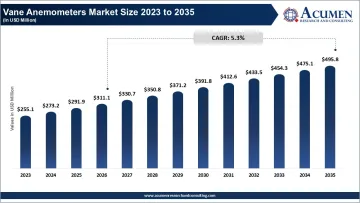
The market for vane anemometers is driven by the rising advancements in the area of industrial automation and smart technologies in building control systems. The increasing importance of energy efficiency and sustainability in commercial and industrial establishments has also increased the usage of vane anemometers for measuring and controlling air flows. These measuring instruments play a significant part in ensuring heating, ventilation, and air conditioning system efficiency and facilitate proper ventilation while maintaining ambient quality inside buildings. The need for compliance with standards and regulations related to safe working environments and environmental protection is also increasing the demand for these measuring instruments.
Vane Anemometers Market Report Highlights
- By Region, the North America vane anemometers market garnered a revenue of USD 100.7 million in 2025.
- By Region, the Asia-Pacific vane anemometers market is estimated to grow at a lucrative CAGR of over 6.6% from 2026 to 2035.
- By Product Type, the handheld vane anemometers segment represented 44% of the total market share in 2025.
- By Technology, the digital segment accounted for 48% of the market share in 2025.
- By Application, the HVAC system monitoring application accounted for 33% of the vane anemometers market share in 2025.
- By End Use, the industrial facilities segment represented 41% of the total market share in 2025.
Vane Anemometers Market Dynamics
Market Drivers
Rising Demand for Automation
- The increasing need for automation solutions across industries is a major driver for the market. With the growing need among companies to improve productivity and lower labor costs, the adoption of automated measuring solutions is increasing. The industries are especially increasing their efforts to apply automation across all their processes to improve efficiency. Moreover, the capability of the automated solutions to offer real-time data is expected to improve decision-making processes across diverse industries.
Growing Need for Weather Monitoring and Climate Research
- The increasing demand for weather monitoring and climate studies is driving the market demand. Given the increase in extreme weather disasters and the rising awareness about global warming, meteorological departments and research institutions have been making huge investments in recent times in state-of-the-art monitoring equipment. For monitoring purposes of wind speed and direction, vane anemometers find widespread applications in weather stations and research laboratories owing to their accuracy and ease of use. Their portability and adaptability extend the usages in both the field and the laboratory. The integration of digital technologies and IoT connectivity has also upgraded the functionality of vane anemometers, allowing remote data collection and real-time data analysis. This is of particular value in large-scale environmental monitoring projects.
Market Restraints
Limited Accuracy in Low-Flow and Turbulent Conditions
- Vane anemometers tend to face challenges in terms of measurement accuracy, especially in low airflow and turbulence conditions, thus hindering their adoption in the specialized industry and laboratory settings. This has made end users opt for more sophisticated technology such as hot-wire anemometers and ultrasonic anemometers, thus impeding growth in the market.
Price Sensitivity and Availability of Low-Cost Substitutes
- The market is subject to heavy competitive pressure from low-priced basic airflow meters and multifunction environmental testers. Customers with low spending power tend to prefer less expensive products. As a result, it delays acceptance of highly sophisticated models with digital technology. Price sensitivity limits the growth of the premium market.
Market Opportunities
Surge in Construction Activities
- The rising demand for construction, especially in the emerging markets, is adding to the growth of the market. The rising cases of urbanization worldwide result in increased demand for effective ventilation systems in the building industry, and the use of the vane anemometer has seen a rise in the building inspection field in an effort to meet the building codes and standards. Moreover, the rising demand for green building, along with the adoption of eco-friendly construction, has increased the demand for energy-saving solutions in the building industry, and the use of the vane anemometer has emerged as the most important step in the process of calibrating the systems designed for ventilation purposes.
Technological Advancements
- The rising demand for smart buildings as well as smart HVAC solutions creates a massive opportunity for vane anemometers. The use of IoT-based airflow metering solutions providing real-time information, as well as remote and predictive maintenance, is gaining momentum. This acts as a robust opportunity for companies offering advanced and cloud-connected measurement solutions.
- The HVAC systems market size accounted for USD 212.6 Billion in 2023 and is estimated to achieve a market size of USD 397.6 Billion by 2032 growing at a CAGR of 7.3% from 2024 to 2032. The growth is driven by driven by increasing infrastructure development, energy-efficient building upgrades, and higher adoption of smart HVAC technologies across commercial and residential sectors.
Vane Anemometers Market Report Scope
| Attribute | Details |
|---|---|
| Vane Anemometers Market Size 2025 | USD 291.9 Million |
| Vane Anemometers Market Forecast 2035 | USD 495.8 Million |
| Vane Anemometers Market CAGR During 2026 – 2035 | 5.3% |
| Analysis Period | 2023 – 2035 |
| Base Year | 2025 |
| Forecast Data | 2026 – 2035 |
| Segments Covered | By Product Type, By Technology, By Application, By End Use, and By Geography |
| Regional Scope | North America, Europe, Asia-Pacific, Latin America, and Middle East & Africa |
| Key Companies Profiled | Siemens AG, Vaisala, Gill Instruments, FT Technologies, PCE Instruments, Lufft (OTT Hydromet), Davis Instruments, NRG Systems, Kanomax USA Inc., and Adolf Thies GmbH & Co. KG. |
| Report Coverage | Market Trends, Drivers, Restraints, Competitive Analysis, Player Profiling, Covid-19 Analysis, Regulation Analysis |
Vane Anemometers Market Regional Insights
North America dominated the vane anemometers market by garnering a major market share in 2025. The market is propelled by the well-developed industrial infrastructure, widespread use of HVAC systems, and the requirement for proper ventilation systems at work environments. This is owing to the fact that industrial sectors such as manufacturing, aviation, pharmaceuticals, automotive, and power demand accurate measurement of airflow to ensure optimum efficiency. The growth is also spurred by the rate of adaptation to digital as well as IoT-reliant airflow measurement systems, owing to the advanced technological development and the need to conserve energy. The presence of smart building solutions, cleanroom solutions, and sustainable development is an important driver of the dominance of this market.
| Region | Market Share, 2025 (%) | Key Highlights |
|---|---|---|
| North America | 35% | Stable demand driven by HVAC optimization, industrial safety regulations, and early adoption of connected airflow measurement tools. |
| Europe | 26% | Strong market due to stringent energy-efficiency norms and IAQ standards. |
| Asia-Pacific | 23% | Fastest-growing region driven by rapid industrialization, infrastructure development, expanding HVAC installations, and increasing adoption of smart building technologies. |
| MEA | 9% | Growth supported by rising construction, demand for cooling systems, and gradual adoption of ventilation monitoring in commercial and industrial spaces. |
| Latin America | 7% | Steady demand from industrial and HVAC segments. |
The Asia-Pacific market is expected to observe a significant growth throughout the forecast period. This is due to the high demand for vane anemometers in this region because of fast-paced industrialization and development in the field of electronics and semiconductor production in China, India, South Korea, and Southeast Asian countries. With the imposition of tougher regulations related to HVAC system efficiency and an increasing emphasis on occupational health and safety in this region, the market will show an upward trend toward the use of modern HVAC systems and environmental monitoring solutions.
Vane Anemometers Market Segmental Insights
The worldwide market for vane anemometers is split based on product type, technology, application, end use, and geography.
Product Type Insights
The handheld vane anemometers segment dominated the vane anemometers market in 2025. Portable and easy to operate, handheld vane anemometers are in huge demand. Handheld vane anemometers are widely utilized by HVAC technicians, field researchers, and maintenance personnel for swift and accurate on-site measurement of airflow. There is an increased trend toward on-site diagnostics and preventive maintenance in both commercial and industrial sectors that is further fuelling demand for handheld models of anemometers. Their compact design combined with digital displays and integration into mobile apps has ultimately made them most preferrable among professionals desiring dependable and user-friendly measurement tools.
| Product Type | Market Share, 2025 (%) | Key Highlights |
|---|---|---|
| Handheld Vane Anemometers | 44% | Handheld devices dominate due to ease of use and cost-efficiency. |
| Fixed/Wall-Mounted Vane Anemometers | 22% | Growth is driven by adoption in HVAC systems, industrial ventilation control, cleanrooms, and building automation. |
| Portable Vane Anemometers | 18% | Portable units remain relevant for field inspections and environmental monitoring. |
| Wireless/IoT-Enabled Vane Anemometers | 16% | Fastest-growing category, supported by Industry 4.0, predictive maintenance, smart buildings, and remote wind/airflow monitoring requirements. |
Technology Insights
Based on technology, the market is classified into analog/basic devices, digital, and smart/IoT Connected.
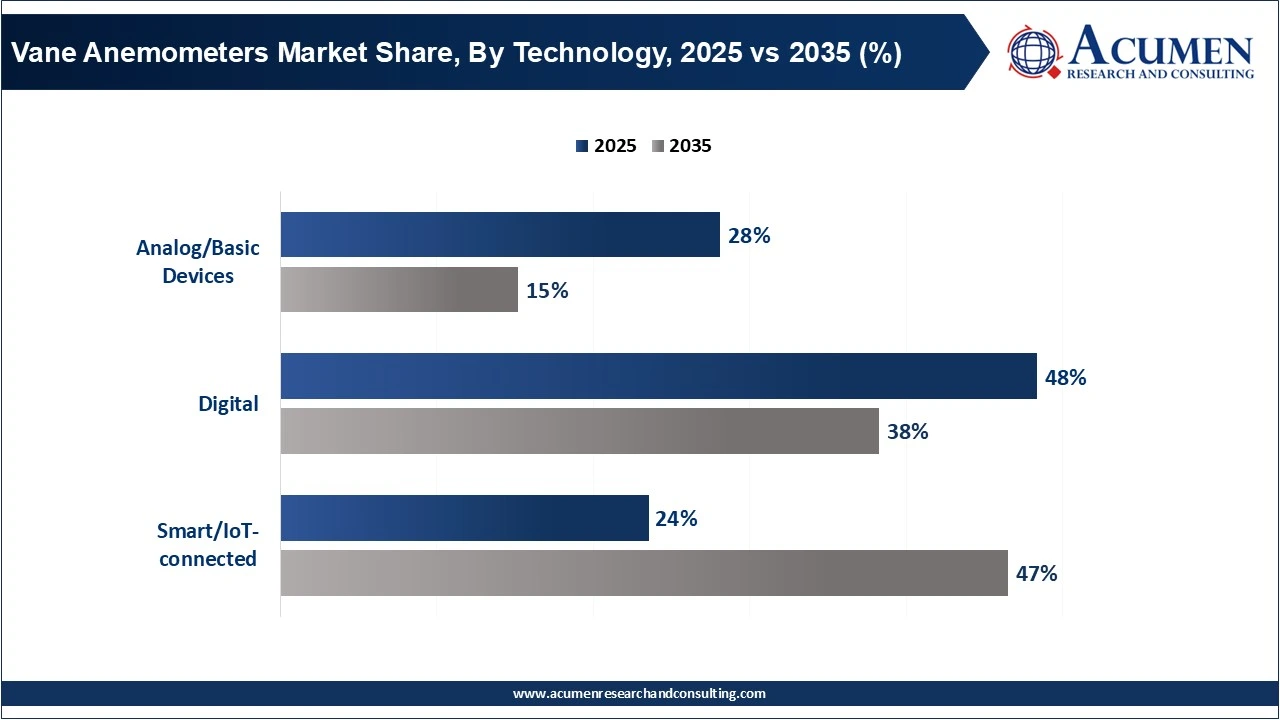
In 2025, the digital technology dominated the market owing to the better accuracy and ease of operation and data logging functionality they possess. Digital anemometers are preferred in the industrial sector because of the real-time monitoring and fast diagnostics and improved reliability in calculating airflow they offer and the easy connectivity with the latest industrial automation technology and the capacity to archive and transmit data for improved adoption.
| Technology | Market Share, 2025 (%) | Key Highlights |
|---|---|---|
| Analog/Basic Devices | 28% | Analog models still serve low-cost, entry-level, and educational applications, but their market share is projected to decline significantly as industries shift toward higher-precision and connected devices. |
| Digital | 48% | Digital anemometers dominate due to their accuracy, data logging, and portability |
| Smart/IoT-connected | 24% | This is the fastest-growing segment, driven by Industry 4.0, smart building systems, environmental monitoring networks, and automated industrial workflows. |
Application Insights
Based on application, the market is classified into HVAC system monitoring, industrial process monitoring, environmental & meteorological monitoring, research & laboratory use, and cleanrooms & indoor air quality.
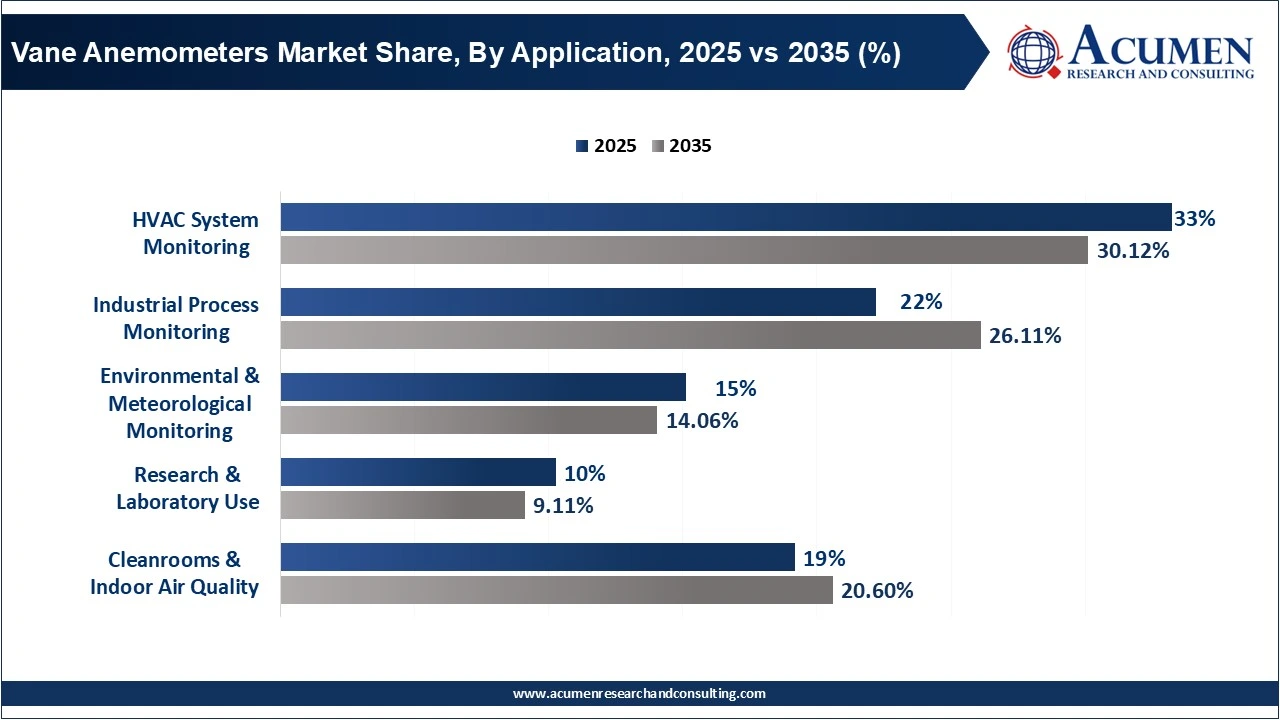
The HVAC system monitoring application led the vane anemometers sector. The segment is dominant because of the crucial role played by vane anemometers to guarantee balanced, accurate, and efficient ventilation in buildings. IAQ, efficiency standards, as well as the rising adoption of smart HVAC controllers, are major drivers of market performance that contribute to the dominance of this market share. Vane anemometers are applied to check air movement in a ventilation duct, fix air ventilation problems, or optimize ventilation performance.
| Application | Market Share, 2025 (%) | Key Highlights |
|---|---|---|
| HVAC System Monitoring | 33% | HVAC remains the largest application due to widespread adoption in commercial buildings, ventilation testing, and energy-efficiency audits. |
| Industrial Process Monitoring | 22% | Growth is driven by automation, safety compliance, airflow control in manufacturing, and integration of IoT-enabled sensors across industrial facilities. |
| Environmental & Meteorological Monitoring | 15% | Steady demand from weather stations, environmental surveys, and field monitoring. |
| Research & Laboratory Use | 10% | Used for airflow experiments, fluid dynamics studies, and controlled testing environments. |
| Cleanrooms & Indoor Air Quality | 19% | Fast-growing due to stricter contamination control standards, expansion of pharma/biotech cleanrooms, and rising indoor air quality monitoring in healthcare and commercial spaces. |
End Use Insights
The industrial facilities segment held the largest market share in 2025. This is primarily attributed to the significant usage of vane anemometers in ensuring ventilation efficiency, as well as worker safety. Moreover, the significance of air movement within industries is high, as it aids in controlling emission levels, particulates, and optimizes the performance of sensitive equipment. Decreased dependence on manual monitoring, along with rising standards of worker safety, has supported the adoption of vane anemometers.
| End Use | Market Share, 2025 (%) | Key Highlights |
|---|---|---|
| Industrial Facilities | 41% | Industrial plants increasingly adopt vane anemometers for process airflow monitoring, worker safety, equipment ventilation, and predictive maintenance. |
| Commercial Buildings | 35% | Stable demand from HVAC balancing, energy audits, and indoor ventilation control. |
| Residential | 13% | Modest segment driven by home HVAC setup, indoor air quality concerns, and rising awareness of ventilation. |
| Others | 11% | Incremental growth supported by diversified niche uses such as greenhouse airflow monitoring, drone-based wind assessment, and athletic training environments. |
Vane Anemometers Market Players
- Siemens AG
- Vaisala
- Gill Instruments
- FT Technologies
- PCE Instruments
- Lufft (OTT Hydromet)
- Davis Instruments
- NRG Systems
- Kanomax USA Inc.
- Adolf Thies GmbH & Co. KG.
Vane Anemometers Market Segmentation
By Product Type
- Handheld Vane Anemometers
- Fixed/Wall-Mounted Vane Anemometers
- Portable Vane Anemometers
- Wireless/IoT-Enabled Vane Anemometers
By Technology
- Analog/Basic Devices
- Digital
- Smart/IoT-connected
By Application
- HVAC System Monitoring
- Industrial Process Monitoring
- Environmental & Meteorological Monitoring
- Research & Laboratory Use
- Cleanrooms & Indoor Air Quality
By End Use
- Industrial Facilities
- Commercial Buildings
- Residential
- Others
By Region
- North America
- U.S.
- Canada
- Europe
- U.K.
- Germany
- France
- Spain
- Rest of Europe
- Asia-Pacific
- India
- Japan
- China
- Australia
- South Korea
- Rest of Asia-Pacific
- Latin America
- Brazil
- Mexico
- Rest of LATAM
- Middle East & Africa
- South Africa
- GCC Countries
- Rest of the Middle East & Africa (ME&A)
Looking for discounts, bulk pricing, or custom solutions? Contact us today at sales@acumenresearchandconsulting.com
Frequently Asked Questions

Other Semiconductor and Electronics Reports
December 2025
August 2024
June 2022
November 2022