
6G Market Size, Share, Trends, Report 2026 To 2035
6G Market (By Offering: Infrastructure, Devices, Connectivity Services, Software & Services; By Network Type: Terrestrial Network, Non-Terrestrial Network (NTN), Hybrid Network; By Communication Technology: Terahertz (THz) Communication, AI-Native Networking, Reconfigurable Intelligent Surfaces (RIS), Integrated Sensing & Communication (ISAC), Optical Wireless Communication; By Application: Immersive Communication, Smart Manufacturing, Autonomous Mobility, Smart Cities, Healthcare, Industrial IoT, Defense & Public Safety, Digital Twins; By End User: Telecom Operators, Enterprises, Government & Defense, Consumers) - Global Industry Analysis, Size, Share, Regional Analysis, Trends and Forecast 2026 - 2035
- Last Updated: 07 Aug 2026
- Report Code: ARC3957
- Category: ICT
6G Market Size, Growth Factors 2026 To 2035
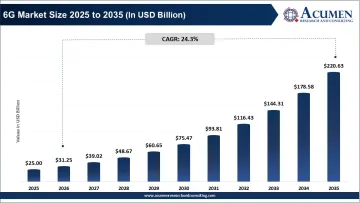
The global 6G market size was recorded at USD 25 billion in 2025; it is estimated to reach at USD 220.63 billion by 2035. The market is expected to witness a promising CAGR of 24.3% during the forecast period of 2026-2035. Growth factors driving the 6G market include increasing investments in next-generation communication technologies, rising demand for AI-powered connectivity, expansion of industrial IoT applications, and the need for ultra-high-speed, low-latency networks to support future digital ecosystems.
Report Highlights
- By region, the Asia-Pacific captured the largest share of the global 6G market at 45.0% in 2025, driven by the presence of leading telecom equipment manufacturers, strong semiconductor supply chains, and coordinated efforts by governments and technology companies to establish 6G leadership.
- By region, the Middle East & Africa is anticipated to witness the highest CAGR of 31.5% from 2026 to 2035, as countries across the region accelerate investments in digital infrastructure, artificial intelligence, smart cities, and next-generation communication networks.
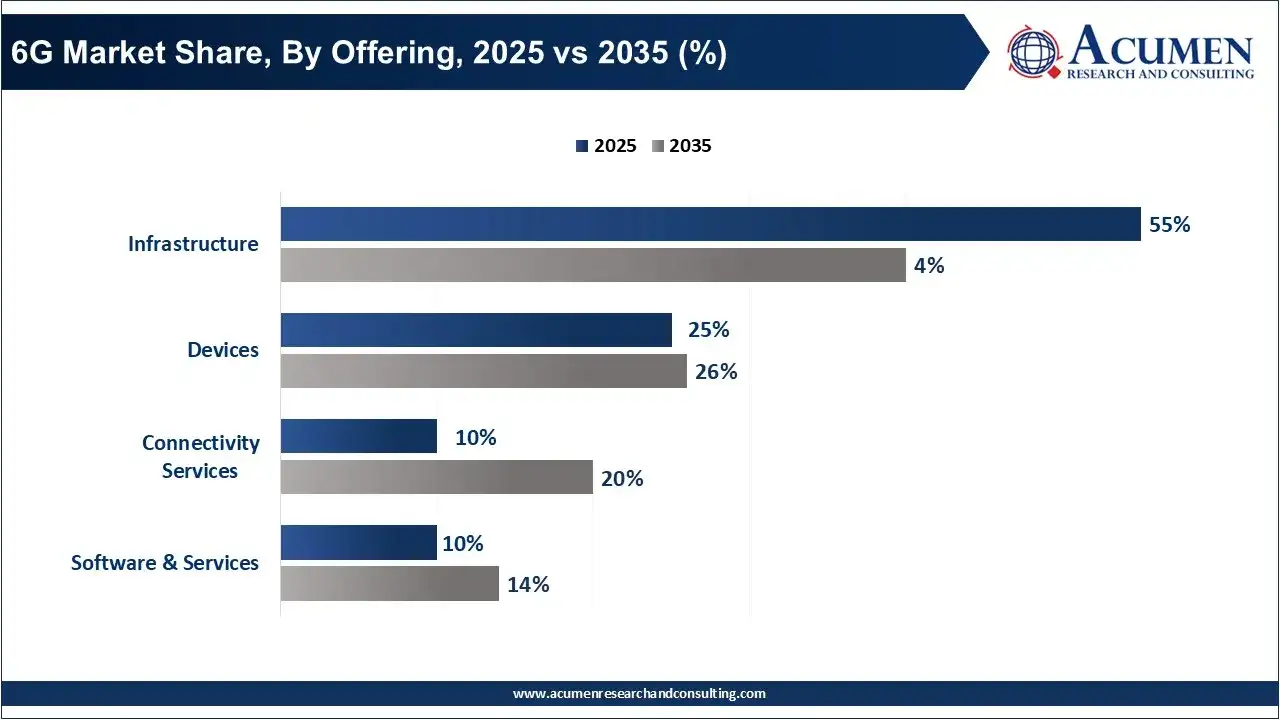
- By offering, the infrastructure segment represented 55.0% of the global 6G market in 2025, reflecting the industry's current focus on building the foundational network technologies required for future commercialization, including advanced RAN, core networks, and edge infrastructure.
- By offering, the connectivity services segment is estimated to experience the fastest growth with a CAGR of 34.2%, due to increasing monetization opportunities from enterprise applications, private wireless networks, and advanced communication services following commercial 6G availability.
- By network type, the terrestrial network segment maintained its leading position with an 85.0% market share in 2025, owing to its established deployment base and its importance in supporting future upgrades to AI-driven wireless networks.
- By network type, the hybrid network segment represented the second-largest share of 10.0% in 2025, as demand increases for seamless connectivity solutions combining terrestrial networks with satellite and aerial communication platforms.
- By communication technology, the terahertz (THz) communication segment accounted for the highest share of 35.0% in 2025, as researchers and industry players continue advancing high-frequency technologies required for future ultra-fast wireless communication.
- By communication technology, the AI-native networking segment secured the second-largest position with a 25.0% share in 2025, supported by the growing need for automated network operations, intelligent resource allocation, and self-optimizing infrastructure.
- By application, the immersive communication (XR & holography) segment represented the leading share of 25.0% in 2025, as enterprises and consumers increasingly explore virtual experiences, holographic interaction, and real-time immersive applications.
- By application, the smart manufacturing segment accounted for 20.0% of the market in 2025, driven by the expansion of Industry 4.0 initiatives, connected production systems, and demand for reliable industrial communication networks.
- By end user, the telecom operators segment contributed the highest share of 60.0% in 2025, due to their critical role in funding 6G research, conducting network trials, developing infrastructure, and preparing ecosystems for commercial rollout.
- By end user, the enterprises segment contributed 20.0% of the market share in 2025, supported by increasing requirements for secure, low-latency connectivity across manufacturing, healthcare, logistics, energy, and other digital industries.
6G Market Outlook
China, South Korea, Japan, the U.S. and Europe are investing heavily in research and development on 6G, spectrum, trials, and enhanced infrastructure to secure an early lead in the new ecosystem. It is the integration of key technologies, like AI-native networking, terahertz, integrated sensing and communications (ISAC), digital twin, edge AI, and non-terrestrial networks (NTN). 6G is seen to bring forth new business opportunities in autonomous vehicles, smart manufacturing, health care, defense, and smarter cities.
“As commercial 6G deployments are expected to begin around 2030, the 2025–2029 period represents a foundational ecosystem development phase, where market growth is primarily driven by R&D activities, technology trials, infrastructure preparation, standardization efforts, and early solution development.”
Key investments by the leading companies like Nokia, Ericsson, Samsung, Huawei, Qualcomm, NEC and more in the new era of 6G is largely for making the new technological ecosystems a ready for mass adoption phase around 2030 when the world gets started with widespread adoption of 6G technologies in different sectors to drive in the greater CAGR.
6G Network Global Patent Analysis
- Patent trends in top technology markets accelerate as countries increase funding for 6G technology leading innovation growth by China, South Korea, Japan, and other leading countries. Global applications reached 3.7 million in 2024, growth was driven largely from China.
- Governments have allocated 6G research funding at large scales, with China, the U.S., Japan, South Korea and Europe all competing for technology leadership via state-funded research programs and collaborations with industry & academic partners.
- European companies enhance their 6G patent position, through research driven by Nokia, Ericsson and through several academic-industry collaborations focused on areas such as; open RAN, Network automation, green connectivity, and future air interface technologies.
- Japan continues to be an essential 6G patent contributing nation driven by key players such as NTT, NEC, Fujitsu and Panasonic, as it invests in national R&D activities focused on areas such as: ultralow latency communications, terabit-speed communications and energy-efficient network architecture.
- Chinese firm Huawei Technologies solidifies leadership in next-generation wireless technology, Huawei remains the lead contributor with huge R&D investments in 6G technology including terahertz communication, A I-native networks and network sensing technologies.
Market Dynamics
What Is Driving the Global Race Toward 6G?
The push for 6G worldwide is fueling the race across technology leadership, national geopolitics, AI application expansion, and ensuring we support even more data-consuming digital economies without the capacity constraints of 5G. Governments in China, the US, Japan, South Korea, and Europe now consider 6G as essential national infrastructure and are pursuing research, semiconductor prowess and spectrum development to preserve long-term competitive advantages.
Telecom operators and vendors are fast tracking their R&D because future revenues can only stem from AI-native networks, industrial automation, autonomous driving, virtual/augmented reality and other immersive digital experience applications, all which heavily depend on 6G networks.
Moreover, companies who hold influence over the development of future 6G standards and own critical patents will acquire substantial license and ecosystem benefits, thereby making the race for 6G a business necessity rather than a technology driven aspiration.
Which Challenges Could Delay Commercial 6G Deployment?
Despite significant investment activity, several factors may hinder large scale 6G commercialization. Standardization issues represent one of the greatest challenges as achieving agreement on spectrum allocation, network architecture, interoperability, and security across the world is still not possible even by late 2020s. Huge advancement in chip technology, radio propagation, and power consumption for THz communication and integrated sensing, are still missing to pave way for their commercialization.
However geopolitical issues such as trade wars, restrictions on technology transfer and control over semiconductor components can also impact the global technology development and adoption. Finally, the business case for 6G is also uncertain for many parts of the world especially where 5G is still on rollout and the operator can only take on another large scale network investment when the returns are realized for their present 5G deployment.
Where Will the Biggest Revenue Opportunities Emerge?
The largest revenues are expected to come first from the enabling commercialization ecosystem and then from enterprise and industry specific services, for the 6G market. Over the 2025-2029 pre commercialization stage, spending on network infrastructure, semiconductors, AI based network software, cloud native platforms, spectrum studies, test equipment and systems integration services is estimated.
When it is commercialized around 2030, high value applications should form around private 6G networks, manufacturing solutions for smart factories and industrial automation, driverless automotive, automation for healthcare services, communications for defense applications, and platforms for the generation of digital twin technologies.
AI native network orchestration, cyber security, managed network solutions, should represent considerable recurring revenues and thus for technology service providers. Regionally Asia-Pacific is anticipated to be rich in revenue opportunities that reflect their infrastructure based and manufacturing industrial bases and should take a commanding share of infrastructure related revenue.
Regional Analysis
What Made Asia Dominate the 6G Market?
The Asia-Pacific 6G market size was valued at USD 11.25 billion in 2025 and is estimated to surpass USD 88.25 billion by 2035 at a CAGR of 22.6% during the forecast period of 2026-2035.
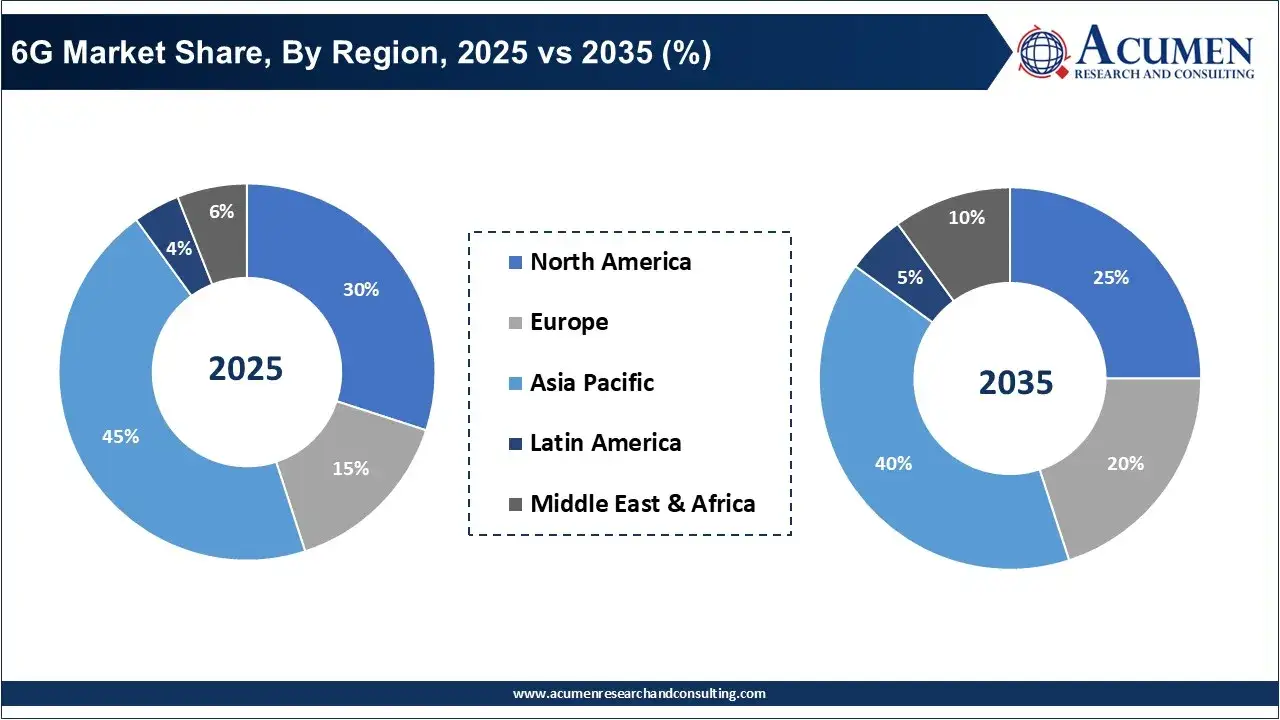
Asia-Pacific accounted for 45% of the global 6G market in 2025, owing to robust government support for new research, a mature telecommunications ecosystem, and a commanding position in the semiconductor and electronics industry to be the top regional market for 6G. Indeed, countries like China, Japan, South Korea and India are at the global forefront of the pre-commercial 6G deployment, heavily investing in areas like wireless research, AI-native networking, terahertz communications, satellite network integration, and next generation infrastructure.
As compared to commercial mature telecom markets, the 6G industry is dominated by R&D investment, testbed pilots, technology validation and standardization efforts, all the while being geographically centered on the Asia-Pacific region itself.
Moreover, globally prominent technological firms such as Huawei, Samsung Electronics, NEC, Fujitsu, MediaTek, and various other semiconductor manufacturers, empower the Asia-Pacific with the world's most vibrant network and hardware innovations, accelerating advancements in communication hardware, AI processors, next generation antennas, and networking software.
Top Government Funding Programs in Asian Countries for 6G Network
| Country | Government Program | Funding / Investment |
|---|---|---|
| Japan | Beyond 5G (6G) Fund Program administered by the National Institute of Information and Communications Technology (NICT) | ¥300 billion (approx. US$2 billion) |
| South Korea | K-Network 2030 & 6G R&D Initiative led by the Ministry of Science and ICT | Over KRW 625 billion (approx. US$480 million) for core 6G R&D through 2028 |
| China | National 6G Research & Development Program under the Ministry of Science and Technology | Multi-billion-dollar government-backed investment (undisclosed) |
| India | Bharat 6G Vision & Technology Development & Investment Promotion (TDIP) Scheme | ₹203 crore (2026–2031) under the TDIP Scheme, alongside support through the Bharat 6G Alliance and ANRF |
| Singapore | Future Communications Research & Development Programme (FCP) | S$70 million (approx. US$52 million) |
| Taiwan | National 6G Technology Development Program | NT$20 billion+ (multi-phase government support) |
How is Middle East & Africa Growing in 6G Market?
The Middle East & Africa is projected to register the fastest CAGR of 31.5% between 2026 and 2035, driven by aggressive digital transformation strategies, increasing investments in smart infrastructure, and growing government support for future communication technologies. Although the region currently represents a relatively smaller share of the global market, countries such as the United Arab Emirates, Saudi Arabia, and Qatar are positioning themselves as early adopters of advanced wireless technologies through substantial investments in AI, cloud computing, smart cities, and next-generation telecom infrastructure. National digital transformation programs, including Saudi Vision 2030 and the UAE's 6G roadmap, are encouraging telecom operators to prepare for future commercial deployment by investing in network modernization, edge computing, satellite connectivity, and AI-enabled telecommunications platforms.
Segmental Insights
Offering Insights
Infrastructure Dominated the 6G Market in 2025
In 2025, the infrastructure segment held 55.0% share in the global 6G market. This dominance was mainly due to the pre-commercial state of the existing 6G network, and the investments made in the network R&D, pilot testing, AI-native networking architecture, spectrum research, and network infrastructure upgradation, instead of commercial services. Government organizations, telecom operators, equipment suppliers, and semiconductor manufacturers are heavily investing in developing the technologies necessary to implement commercial 6G around 2030.
The development and upgrade of radio access networks, cloud-native core networking infrastructure, transport networks, edge computing, and network security are continuously accelerating with operators planning for future ultra-low-latency and AI-enabled wireless networks.
Key mobile infrastructure vendors, such as Nokia, Ericsson, Samsung Electronics, Huawei, NEC, and Fujitsu, continue to invest in the R&D of programmable networks, Open RAN, THz communication, and integrated sensing techniques, thus making the infrastructure segment the dominant share.
Radio Access Network (RAN) Sub-segment Dominated the Infrastructure Segment
The biggest sub-segment in infrastructure 2025, RAN, achieved an overwhelming market share of 45% as a result of the constant new investments in new-generation base stations, new AI-native radios and their development trends, increased efforts in massive MIMO development, Open RAN architectures and terahertz for wireless transmission technologies. The telecom network operators prioritized modernization for the future planning of 6G networks.
Accounting for 20.0%, the core network sub-segment in 2025 is evolving toward fully cloud-native, software-defined, and AI-driven architectures capable of autonomous traffic management, network slicing, and distributed intelligence.
Connectivity Services to Register the Fastest CAGR Through 2035
Connectivity services are expected to report highest growth in CAGR of 34.2% during forecast period as commercial 6G services around 2030, where operators further monetize enterprise advanced connectivity services, Private wireless network services and emerging 6G based Mobile Services.
Commercialization, which will begin in early-2030s will continue to dominate across manufacturing, automotive, healthcare, logistics and transportation, smart cities and government and defense sectors will drive adoption more rapidly.
Consumer Mobile Services Sub-segment Dominated the Connectivity Services Segment
For connectivity services segment, in 2025 the consumer mobile sub-segment represented 60.0% portion as this category has large mobile subscribers globally and mobile broadband is transforming to AI driven immerse data rich services. 6G will launch globally not until near 2030, telecommunications service operators in global are in preparation and investment for this advancement using the preparation of technology such as future generation mobile network, the spectrum plans, as well as the AI-native designs and improved modes for service deliveries for future demands of consumer.
Enterprise connectivity sub-segment represented 15.0% of the connectivity services segment in 2025 and is expected to witness substantial expansion as organizations accelerate digital transformation initiatives and increasingly adopt AI-driven business operations. Enterprises across manufacturing, healthcare, logistics, financial services, retail, and energy are investing in cloud-native infrastructure, industrial IoT, edge computing, and intelligent automation, creating strong demand for highly reliable, secure, and low-latency communication networks. The transition toward Industry 4.0, autonomous production systems, predictive maintenance, and digital twin technologies is encouraging businesses to move beyond conventional enterprise networking toward intelligent connectivity platforms capable of supporting mission-critical applications.
Network Type Insights
Terrestrial Network Dominated the Market in 2025
Terrestrial networks made 85% market share globally in 2025 The market is still driven by traditional cellular network deployment for an early 6G era due to current investments. Today, the 6G market is heavily driven by upgradation of terrestrial mobile networks and includes AI-native radio access network, cloud-native core networks, fiber backhaul, antenna systems, and edge computing.
6G Market Share, By Network Type, 2025 (%)
| Network Type | Revenue Share, 2025 (%) |
|---|---|
| Terrestrial Network | 85% |
| Non-Terrestrial Network (NTN) | 5% |
| Hybrid Network | 10% |
Hybrid Network Emerged as the Second-Largest Segment
Hybrid networks accounted for a 10.0% global market share in 2025, strategically significant in an era where telecom operators look forward to consolidate terrestrial and non-terrestrial communication platforms onto common infrastructure as a network architect. Hybrid networking enables seamless connectivity across urban, rural, maritime, aviation, and disaster-affected regions by combining conventional cellular infrastructure with satellite systems and high-altitude platforms.
Communication Technology Insights
Terahertz (THz) Communication Dominated the Market in 2025
The share of Terahertz (THz) communication segment was 35.0% in 2025 and is expected to be the prime technology to be developed under the future 6G networks. Data transfer speeds of close to one terabit per second are foreseen with THz frequency together with reduced communication latencies as compare to the current wireless networks.
Governments, universities, telecom equipment manufacturers and semiconductor companies are actively funding R&D of THz transceivers, high advanced antenna systems, signal processing technologies and high frequency semiconductor materials for the overcoming the propagation issues of ultra-high frequency.
6G Market Share, By Communication Technology, 2025 (%)
| Communication Technology | Revenue Share, 2025 (%) |
|---|---|
| Terahertz (THz) Communication | 35% |
| AI-Native Networking | 25% |
| Reconfigurable Intelligent Surfaces (RIS) | 15% |
| Integrated Sensing & Communication (ISAC) | 10% |
| Optical Wireless Communication | 15% |
AI-Native Networking Emerged as the Second-Largest Segment
The share of AI-native networking segment was 25.0% in 2025 and will continue to be one of the emerging trends of commercial 6G networks. While previous wireless network utilized artificial intelligence for the optimization of existing networks the new 6G network is designed based on end to end integration of AI layer based technologies. AI-native networks will perform autonomous resource allocation, predictive maintenance, intelligent trafficking management, dynamic spectrum optimization, and self-healing abilities without human supervision.
Application Insights
Immersive Communication (XR & Holography) Dominated the Market in 2025
Immersive communication, including Extended Reality (XR) and holographic communication, accounted for 25.0% of the global 6G application market in 2025. Technology firms are building AI-enabled XR systems on the basis of edge computing and intelligent communication networks to implement high-interactive applications, so enterprise use of virtual collaboration tools and industrial simulation tools are supporting demand for immersive communication solutions among the first 6G application groups.
6G Market Share, By Application, 2025 (%)
| Application | Revenue Share, 2025 (%) |
|---|---|
| Immersive Communication (XR & Holography) | 25% |
| Smart Manufacturing | 20% |
| Autonomous Mobility | 15% |
| Smart Cities | 10% |
| Healthcare | 8% |
| Industrial IoT | 12% |
| Defense & Public Safety | 7% |
| Digital Twins | 3% |
Smart Manufacturing Emerged as the Second-Largest Application
Smart manufacturing constituted 20.0% of the application segment and was also driven by the high level of adoption of Industry 4.0 across manufacturing industries at global scale. Industrial factories are extensively adopting autonomously driven robots, digital twins, predictive maintenance, machine vision and AI-based quality checking platforms which requires ultra-reliable and low latency connectivity.
As governments push domestically manufacture, automated production line and digital transformation in Asia Pacific, Europe and North America, long-term demand for Industrial 6G applications will grow faster.
End User Insights
Telecom Operators Stood a Significant 60% Share of the 6G Market in 2025
Telecom operators invested money for R&D, network upgrade, spectrum availability, and commercial readiness in the 6G market. As 6 G commercial service is not yet available, this investor segment in the ecosystem has contributed the most to spending on AI-native network architecture, Open RAN technologies, cloud-native core networks, edge compute platforms, and also advanced radios. High grade telecom players all around world especially in North America, Europe, and APAC region are already partnering with equipment suppliers, chipset manufacturers, cloud providers & research firms to run some trials.
6G Market Share, By End User, 2025 (%)
| End User | Revenue Share, 2025 (%) |
|---|---|
| Telecom Operators | 60% |
| Enterprises | 20% |
| Government & Defense | 11% |
| Consumers | 9% |
Enterprises Segment Held Second Largest Share in 2025
Enterprises captured 20% share from the total global 6G market in 2025. With rising adoption of AI technology for industrial processes, increasing investment on infrastructure which supports the needs of industrial automation, public and private cloud deployments and internet-driven connectivity enterprises were found to invest on the new age technologies.
Enterprises (both large and small) in varied vertical (manufacturing, health-care, logistics, mining, etc. Demand was also seen growing rapidly from enterprise sector with future automation requirements such as real-time data collection, intelligent management and monitoring.
6G Market Competitive Landscape
- Nokia: Leading the 6G journey with its focus on AI-native networking, ISAC (integrated sensing and communication) and advanced radio technologies driven by research at Nokia Bell Labs and in collaboration with Hexa-X.
- Ericsson: Focusing on future 6G acceleration with major investments in programmable networks, Open RAN, AI automation of the networks and cloud-native network functions. Samsung Electronics Developing cutting-edge 6G capabilities by researching terahertz (THz) communications, AI-native networking, XR environments, and future semiconductor technologies.
- Huawei Technologies: Expanding its 6G R&D with a strong emphasis on wireless communication through AI, satellite-terrestrial integrated communications, and antenna innovations to enhance intelligent network infrastructure.
- Qualcomm Technologies: Applying its world leadership in cellular modems and chipsets to enable AI-enabled 6G chipsets and connectivity solutions for enhanced compute capacity at the edge. NEC Corporation Strengthening its position in 6G with work in Open RAN innovations, optical wireless communication and partnering with key telcos for future network infrastructure.
- Fujitsu Limited: Prioritizing on the development of high capacity optical networks, AI in communications and energy efficiency as critical to future digital infrastructure. Cisco Systems Increasing capabilities with focus on AI-native networking, cybersecurity, compute at the edge, and cloud networking to drive autonomous and intelligent 6G network functions.
- Intel Corporation: Developing future 6G by investing in chip advancements for the next generation network processing and accelerated compute for cloud native infrastructure and networks powered by artificial intelligence.
- NVIDIA Corporation: Driving a new era in digital by developing world leading platforms forAIin infrastructure, cloud, gaming and networking to transform digital ecosystems and support 6G’s capabilities in digital twins, augmented realityand other innovations.
Top Technologies
| Technology | Function | Key Applications |
|---|---|---|
| AI-Native Networking | Embeds artificial intelligence across network operations for autonomous management and optimization | Self-healing networks, predictive maintenance, intelligent traffic management |
| Integrated Sensing and Communication (ISAC) | Combines wireless communication with environmental sensing | Autonomous vehicles, smart factories, healthcare monitoring, defense |
| Reconfigurable Intelligent Surfaces (RIS) | Uses programmable surfaces to intelligently reflect and optimize wireless signals | Indoor coverage, smart buildings, industrial campuses, urban connectivity |
| Edge AI Computing | Processes AI workloads closer to users and connected devices | Industrial IoT, robotics, autonomous mobility, smart manufacturing |
| Cell-Free Massive MIMO | Employs distributed antennas to provide uniform wireless coverage without traditional cell boundaries | Dense urban environments, stadiums, smart cities |
| Optical Wireless Communication (OWC) | Transmits data using visible light, infrared, or laser technologies | Indoor wireless communication, data centers, aerospace, healthcare |
| Digital Twin Networks | Creates virtual replicas of physical networks for simulation and optimization | Telecom network planning, predictive maintenance, smart infrastructure |
Recent News
- March 2026, Ericsson and Intel announced a strategic collaboration at MWC 2026 to accelerate the commercialization of AI-native 6G. The partnership focuses on advancing compute, cloud, edge, RAN, and core network technologies to enable an open and efficient 6G ecosystem.
- March 2026, Ericsson and SK Telecom signed a Memorandum of Understanding (MoU) to jointly develop AI-RAN, autonomous networks, and 6G technologies. The collaboration includes joint R&D, network trials, and standardization efforts aimed at supporting future commercial 6G deployments through 2031.
Segments Covered
By Offering
- Infrastructure
- Radio Access Network (RAN)
- Core Network
- Transport & Backhaul
- Edge Infrastructure
- Network Security & Optimization Infrastructure
- Devices
- Smartphones
- IoT Devices
- XR Devices
- Customer Premises Equipment (CPE)
- Connected Vehicle Communication Modules
- Connectivity Services
- Consumer Mobile Services
- Enterprise Connectivity
- Private Networks
- Fixed Wireless Access (FWA)
- Software & Services
- Network Management Software
- AI & Network Orchestration
- Security Software
- Consulting
- Deployment & Integration
- Managed Services
By Network Type
- Terrestrial Network
- Non-Terrestrial Network (NTN)
- Hybrid Network
By Communication Technology
- Terahertz (THz) Communication
- AI-Native Networking
- Reconfigurable Intelligent Surfaces (RIS)
- Integrated Sensing & Communication (ISAC)
- Optical Wireless Communication
By Application
- Immersive Communication (XR & Holography)
- Smart Manufacturing
- Autonomous Mobility
- Smart Cities
- Healthcare
- Industrial IoT
- Defense & Public Safety
- Digital Twins
By End User
- Telecom Operators
- Enterprises
- Government & Defense
- Consumers
By Region
- North America
- Europe
- Asia-Pacific
- Latin America
- Middle East & Africa
Looking for discounts, bulk pricing, or custom solutions? Contact us today at sales@acumenresearchandconsulting.com
Frequently Asked Questions

Other ICT Reports
February 2023
November 2022
September 2024
January 2026